
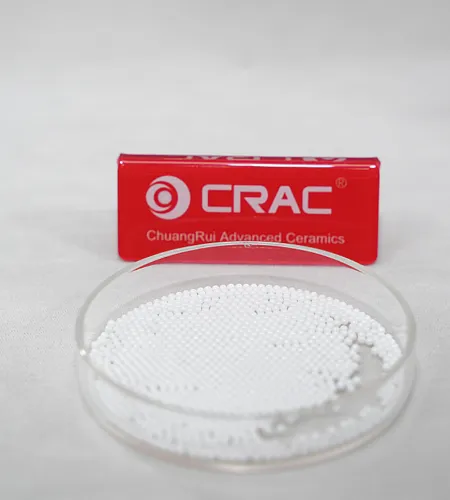
Optimizing Material Processing with Zirconia Beads for Dispersion
Enhance your grinding efficiency and achieve zero-contamination results with CRAC's industry-leading ceramic solutions.
The Challenge of Modern Ultra-Fine Grinding
In the rapidly evolving landscape of material science, achieving sub-micron or nano-scale particle sizes is no longer a luxury—it is a necessity. Industries ranging from new energy lithium batteries to high-end inkjet inks face a common bottleneck: how to maintain high dispersion efficiency while preventing metallic contamination. Standard grinding media often fall short, leading to high wear rates and compromised product purity. At Chuangrui Advanced Ceramics (CRAC), we understand that the key to overcoming these hurdles lies in the selection of premium zirconia beads for dispersion.

What Makes Zirconia Media Superior?
Zirconia (ZrO2) is renowned for its high density, exceptional toughness, and superior hardness. When utilized as zirconia beads for dispersion, these properties translate into higher kinetic energy during the milling process. Unlike alumina or glass beads, yttria-stabilized zirconia media offer:
- High Density (6.0g/cm3): Provides the impact force required for ultra-fine grinding.
- Low Wear Rate: Minimizes media consumption and reduces operational costs.
- Chemical Inertness: Prevents reaction with acidic or alkaline slurries.
CRAC Professional Solutions
ZR95 Nano Series
Designed for high-end applications, our ZR95 Nano Zirconia Beads are the pinnacle of precision. With sizes as small as 0.05mm, they are ideal for the semiconductor and pharmaceutical sectors.
Y-Zr-3Y Series
The Yttria Stabilized Series offers the perfect balance between cost and performance, widely used in the lithium battery industry.
High Purity Media
For zero-pollution requirements, our zirconia beads for dispersion ensure that your white pigments or medical materials remain untainted throughout the process.
Expertise and Industry Applications
Based on our extensive experience serving global clients in the pigment and dye industry and pharmaceutical industry, we have found that utilizing the correct density of zirconia beads for dispersion can increase throughput by up to 30%. In the manufacturing of cathode materials for batteries, the high wear resistance of CRAC beads prevents iron and other metallic impurities from leaching into the slurry, which is critical for battery safety and longevity.
Our production process adheres to strict quality controls, ensuring that every batch of beads maintains uniform sphericity and internal density, preventing shattering even under high-intensity bead mill conditions.
Frequently Asked Questions
1. How do I choose the right size of zirconia beads for dispersion?
The general rule is that the beads should be 10-20 times larger than the initial particle size of the material, and the final target particle size should be approximately 1/1000th of the bead diameter. For nano-dispersion, sizes below 0.3mm are typically recommended.
2. Can I get a sample for testing?
Yes. We understand the importance of validation in industrial processes. CRAC provides free samples for qualified industrial inquiries. Please contact our technical team at crac@crac-cn.com to specify your requirements.
3. What is the expected service life of CRAC zirconia beads?
While the service life depends on the hardness of the material being ground and the mill speed, our zirconia beads for dispersion are engineered to offer 2-3 times the wear resistance of standard industrial beads, significantly extending replacement cycles.
Ready to Elevate Your Grinding Efficiency?
Contact Chuangrui Advanced Ceramics today for a technical consultation or a custom quote.
© 2026 Chuangrui Advanced Ceramics (CRAC). All Rights Reserved. Precision Engineering for a High-Tech World.
Frequently Asked Question
Do you have any question?
Zirconia beads are high-performance grinding media made from zirconium dioxide. They offer superior hardness, wear resistance, and chemical inertness. These properties make zirconia beads ideal for various industrial applications, including milling, dispersion, and grinding processes, where they enhance efficiency, improve product quality, and extend equipment life.
Zirconia beads are more durable and efficient than many other grinding media due to their high density and hardness. They provide better energy transfer, leading to faster grinding and finer particle sizes. Their superior wear resistance ensures a longer service life, reducing the need for frequent replacements and thus lowering operational costs. Additionally, their chemical inertness prevents contamination, making them suitable for sensitive applications.
Yes, zirconia beads are versatile and suitable for both wet and dry milling processes. In wet milling, they enhance the grinding and dispersion of materials in liquids, improving process efficiency. In dry milling, their hardness and density allow effective grinding and particle size reduction without the need for liquids, making them ideal for a broad range of industrial applications.
Industries such as pharmaceuticals, mining, ceramics, electronics, and paint manufacturing benefit significantly from zirconia beads. In pharmaceuticals, they ensure precise milling of active ingredients. In mining and ceramics, they are used to grind hard materials. In electronics, they produce uniform particle sizes for advanced components. In paint manufacturing, they help achieve consistent pigment dispersion, enhancing product quality.
Zirconia beads are ideal for high-temperature applications due to their excellent thermal stability and resistance to thermal shock. They maintain their mechanical properties and structural integrity at elevated temperatures, making them suitable for environments such as industrial furnaces, high-temperature milling processes, and advanced manufacturing systems. This ensures reliable performance and longevity under extreme conditions, providing consistent results in demanding applications.
Absolutely, zirconia beads can be customized to meet specific industrial needs. Manufacturers can adjust the size, composition, and surface finish to achieve desired properties, ensuring optimal performance for particular applications. This customization allows zirconia beads to be tailored for fine grinding, high-temperature milling, or chemical processing, enhancing overall efficiency and effectiveness.