A ceramic ball milling jar is the heart of any planetary ball mill setup — it directly influences grinding efficiency, final particle size, and most critically, sample purity. Whether you are milling battery cathode materials in a research lab or processing pharmaceutical powders at pilot scale, the jar material, volume, and design you choose determine the success of your milling operation.
Yet many engineers and lab technicians default to whatever jar ships with their mill, overlooking how a mismatched jar material can introduce ppm-level contamination, crack under impact, or wear out in weeks. This guide walks you through every decision point — from material chemistry to jar geometry — so you can select a ceramic ball milling jar that delivers consistent, contamination-free results for your specific application.
At a Glance: Three Jar Materials Compared
1
Zirconia
Density 6.0 g/cm³
Hardness 1,200 HV
Max purity 99.9%
Best for: High-purity, nano-grinding, zero contamination
|
2
Alumina
Density 3.9 g/cm³
Hardness 1,100 HV
Purity up to 99.7%
Best for: Routine grinding, cost-sensitive, moderate purity
|
3
Nylon / PA
Density 1.1 g/cm³
Hardness ~100 HV
Metal-free
Best for: Soft materials, no ceramic cross-contamination
|
.png)
Figure 1: Zirconia ceramic ball milling jar with polished interior
|
.png)
Figure 2: Various ceramic milling jar sizes for lab and pilot applications
|
Jar Materials: Chemistry, Performance & When to Use Each
The jar material is the single most important selection variable. It determines wear rate, contamination risk, maximum milling energy, and chemical compatibility with your sample. There is no universal "best" — each material excels in a specific niche.
Yttria-Stabilized Zirconia (YSZ) — The Gold Standard
Zirconia jars, particularly Y-TZP (3 mol% yttria-stabilized), offer the best combination of hardness, toughness, and wear resistance in the ceramic family. Their 6.0 g/cm³ density generates higher impact energy per collision than any other ceramic jar, accelerating grinding kinetics by 30-50% compared to alumina jars of the same volume.
| Property | Value | Significance |
| Density | 6.0 g/cm³ | Highest impact energy per collision |
| Hardness | 1,200 HV | Minimal jar wall wear into sample |
| Fracture Toughness | 6-8 MPa·m¹⁻² | Resists cracking under high-energy impact |
| Wear Rate | ~3 ppm/hr | Near-zero contamination source |
| pH Range | 2-14 | Full chemical compatibility |
Ideal applications: Lithium battery cathode/anode materials, pharmaceutical APIs, semiconductor CMP slurries, high-purity ceramics, nano-powder synthesis (<100 nm target D50).
Alumina (Al₂O₃) — The Workhorse
High-purity alumina (≥99.5%) jars offer excellent cost-performance ratio for applications where extreme purity or toughness is not required. At roughly 25-40% the cost of YSZ, they are the default choice for routine laboratory grinding and pilot-scale material processing.
| Property | Value | Significance |
| Density | 3.9 g/cm³ | Good impact energy, lighter than YSZ |
| Hardness | 1,100 HV | Excellent for most materials |
| Fracture Toughness | 3-4 MPa·m¹⁻² | Lower — use lower ball-to-powder ratios |
| Wear Rate | ~15 ppm/hr | Acceptable contamination for most uses |
| Chemical | pH 3-12 | Avoid strong acids/bases |
Ideal applications: Mineral sample preparation, general ceramics R&D, coating pigment dispersion, food-grade powder processing, geology/geochemistry sample grinding.
Nylon / Engineering Polymer — The Contamination Shield
When your sample cannot tolerate any ceramic contamination — particularly alumina or zirconia pickup — nylon jars provide a metal-free, ceramic-free milling environment. Their low density and hardness mean longer grinding times, but they eliminate the risk of ceramic cross-contamination entirely.
| Property | Value | Significance |
| Density | 1.1 g/cm³ | Lowest impact — longer grinding needed |
| Hardness | ~100 HV | Very soft — near-zero sample abrasion |
| Max Temp | 80°C | Not suitable for dry milling with heat buildup |
| Contamination | Minimal | No Al, Zr, Si pickup |
| Wear Life | ~200 cycles | Consumable — budget for replacement |
Ideal applications: Elemental analysis sample prep (XRF/ICP), organic pigment dispersion, soft material grinding, nanomaterial gentle de-agglomeration, samples where Al/Si/Zr content is being measured.
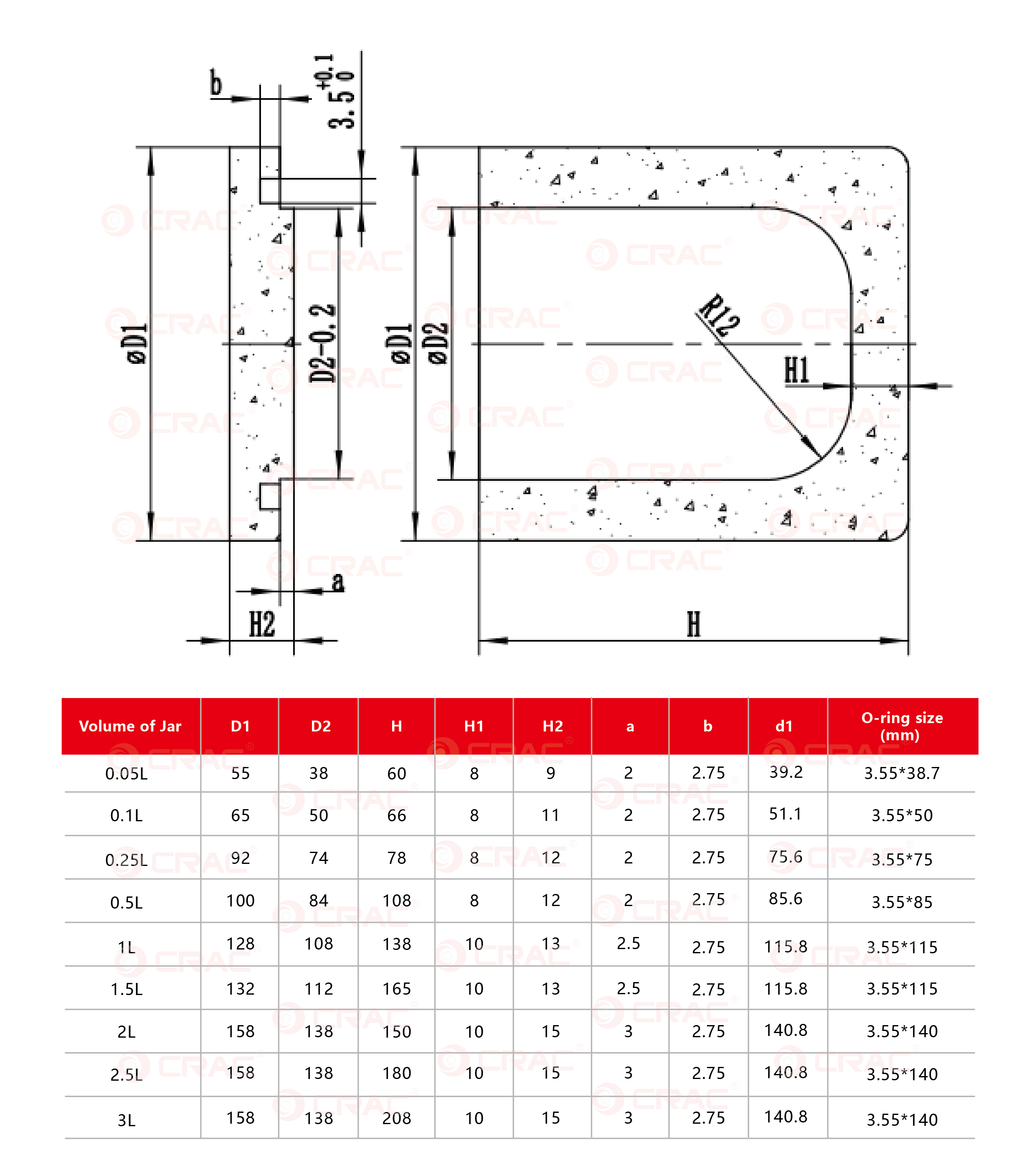
Figure 3: Ceramic ball milling jar comparison across volumes — from 50 mL lab jars to 5 L pilot-scale vessels
Jar Volume: Matching Capacity to Your Milling Goals
Jar volume directly governs batch size, ball-to-powder ratio, and milling energy distribution. Selecting the wrong volume — even with the right material — can result in poor grinding efficiency or sample overheating.
| Volume Range |
Typical Use Case |
Max Sample |
Balls Fill |
Key Consideration |
| 50 – 100 mL |
R&D, material screening |
15 – 33 mL |
30-50% |
Heat dissipation critical; use intermittent milling |
| 250 – 500 mL |
Lab-scale formulation |
80 – 165 mL |
30-50% |
Most common range; good efficiency/heat balance |
| 1,000 mL |
Pilot-scale production |
330 mL |
30-45% |
Consider dual-jar counter-balancing |
| 2,000 – 5,000 mL |
Small-batch production |
660 – 1,650 mL |
25-40% |
Motor power check required; may need reduced speed |
Rule of thumb: Fill the jar with grinding balls to 30-50% of jar volume, and powder to fill the void space between balls. Over-filling reduces impact energy; under-filling wastes capacity and increases jar wall wear.
Jar Design Features That Impact Performance
🔒
Lid & Sealing
PTFE-lined lids prevent leakage during wet milling with solvents. Look for O-ring groove designs over flat gaskets — they maintain seal integrity through thermal expansion cycles. For glove-box operations, quick-clamp lids save significant setup time.
📐
Inner Geometry
Cylindrical jars with rounded bottom corners eliminate "dead zones" where powder accumulates unmilled. Some high-energy designs incorporate internal ribs to disrupt ball trajectory for faster grinding — ideal for tough materials, but avoid for heat-sensitive samples.
⚖️
Wall Thickness
Thicker walls (≥8 mm for YSZ, ≥10 mm for alumina) improve thermal stability and mechanical durability. For zirconia jars, 8-10 mm is standard; thinner walls (5-6 mm) are available for small volumes where weight matters on the mill motor.
🔄
Multi-Jar Adapters
For planetary mills, twin-jar configurations with counter-balanced adapters are essential above 500 mL volume. Running a single large jar without counter-balance can damage the mill's bearings and cause vibration-induced particle size inconsistency.
Ball & Jar Material Compatibility: The Purity Chain
One of the most common and expensive mistakes in ball milling is mismatching ball and jar materials. When grinding balls are harder than the jar, the jar wears into the sample. When balls are softer, the grinding media itself becomes the contamination source.
| Jar Material |
Recommended Ball Material |
Compatibility |
Key Rule |
| YSZ Jar |
YSZ balls |
PERFECT |
Same composition = zero differential wear |
| YSZ Jar |
Si₃N₄ balls |
CAUTION |
Si₃N₄ harder; will abrade YSZ jar walls over time |
| Alumina Jar |
Alumina balls |
PERFECT |
Standard pairing for routine grinding |
| Alumina Jar |
YSZ balls |
AVOID |
YSZ harder → alumina jar wears into sample |
| Nylon Jar |
YSZ or Alumina |
LIMITED |
Avoid high ball-to-powder ratios; nylon wears fast |
The Golden Rule of Jar & Ball Pairing
Always use balls of the same material as — or softer than — the jar. The jar is a consumable with a finite lifetime; the sample purity is non-negotiable. A jar can be replaced; a contaminated 10 kg batch of battery-grade cathode precursor cannot.
Application Matrix: Which Jar for Your Industry?
| Industry / Application |
👑 Best Jar |
🔧 Alternative |
Why |
| ⚡ Lithium Battery R&D |
YSZ |
— |
Metal contamination <50 ppm is mandatory; YSZ is the only ceramic jar meeting battery-grade purity specs |
| 💊 Pharmaceutical API Milling |
YSZ |
Nylon |
FDA requires full extractables/leachables traceability; YSZ for potency, nylon if Al/Si limits are extreme |
| 💎 Semiconductor CMP |
YSZ |
— |
Sub-ppm metal ion levels required; only 99.9% YSZ delivers the necessary purity |
| 🎨 Pigment & Coating Dispersion |
Alumina |
YSZ |
Cost-sensitive volume production; alumina delivers 80% of YSZ performance at 35% of cost |
| ⛏️ Mineral / Geological |
Alumina |
YSZ |
Hard mineral samples wear jars quickly; alumina is the economical choice for high-wear, moderate-purity grinding |
| 🧪 Elemental Analysis (XRF/ICP) |
Nylon |
Alumina |
Cannot introduce Al/Si/Zr into sample; nylon is the only material that won't bias elemental results |
| 🔬 Academic / Multi-Purpose Lab |
Alumina |
YSZ |
Versatile, cost-effective; upgrade to YSZ jars only for specific high-purity projects |
| 🧬 Nanomaterial Synthesis |
YSZ |
— |
Sub-100 nm targets require maximum grinding energy and minimum contamination; YSZ is essential |
6-Step Ceramic Ball Milling Jar Selection Checklist
1
Define your contamination budget
If your final product spec says <100 ppm Zr, YSZ is mandatory. If you're analyzing for Al content, skip alumina entirely. Write down your maximum allowable ppm for Fe, Al, Zr, Si, and Y before choosing a jar.
2
Match to your target particle size
Sub-micron → YSZ jar with 0.1-0.3 mm YSZ balls. Micron-range → Alumina jar with 1-5 mm balls. Jar density and ball size together determine your achievable D50.
3
Select the right volume
Powder mass (g) ÷ powder bulk density (g/cm³) × 3 ≈ minimum jar volume (mL). Example: 100 g of NCM powder (ρ ≈ 2.5 g/cm³) → 40 mL powder volume → select 250 mL jar. Always include void space for ball movement.
4
Verify chemical compatibility
If wet milling with strong acids (pH <2) or bases (pH >12) — YSZ only. Alumina degrades at pH extremes. For organic solvents (NMP, ethanol, acetone), all three materials are compatible; prioritize sealing quality.
5
Check mill compatibility
Confirm your planetary mill's maximum jar weight capacity per station. A 500 mL YSZ jar with balls weighs ~4.5 kg — exceeding some bench-top mill limits. Running overloaded reduces RPM and causes bearing damage.
6
Plan for scale-up
If you'll scale from 250 mL lab jar → 2 L pilot jar → 5 L production jar, use the same jar material across all scales. Switching materials between scales changes grinding kinetics and invalidates your process transfer data.
4 Common Mistakes — and How to Avoid Them
✗
Overfilling the jar
Filling past 60% total (balls + powder) leaves no space for ball movement. Impact energy drops to near zero. Stick to 30-50% ball fill and powder filling only the inter-ball void space.
✗
Using harder balls than the jar
Si₃N₄ balls in an alumina jar means you're grinding the jar itself into your sample. Always match or use softer balls relative to the jar — purity first, jar replacement cost second.
✗
Skipping jar "seasoning"
A new ceramic jar releases higher wear debris in its first few cycles. Run a "sacrificial" milling batch (same material, discard afterward) for 2-3 cycles to stabilize the jar's inner surface before processing real samples.
✗
Ignoring thermal management
High-energy dry milling can heat the jar to 80-100°C in 30 minutes. Pause every 15-20 minutes to cool, or use wet milling for temperature-sensitive samples. Nylon jars begin softening above 80°C.
Quick Win: Start with Jar "Seasoning"
New ceramic jars — especially YSZ and alumina — have micro-roughness from the sintering process that wears off during initial use. Run 2-3 cycles with sacrificial powder (same material you'll be milling) before processing actual samples. This drops initial-cycle contamination by 60-80% and stabilizes the jar surface. Write the date of each jar's first use on its lid — a seasoned jar delivers more consistent results than a brand-new one.
Jar Care & Maintenance: Extending Service Life
Cleaning Protocol
- Rinse immediately after use — dried slurry hardens and adheres to ceramic surfaces
- For YSZ/alumina jars: ultrasonic bath with DI water, 15 min, then wipe dry
- For stubborn residues: fill jar 30% with YSZ balls + DI water, mill at 200 RPM for 5 min
- Never use metal brushes or abrasive cleaners — they scratch the interior
Inspection Checklist
- Check inner walls for visible wear rings — indicates uneven ball distribution
- Inspect lid O-ring for compression set — replace every 50-80 cycles
- Weigh jar periodically: >2% mass loss = excessive wear, retire from critical use
- Look for micro-cracks at rim and thread area — thermal shock from rapid cooling
- Verify lid thread integrity — cross-threading on ceramic jars is irreversible
Conclusion: The Right Jar Makes the Difference
A ceramic ball milling jar is not just a container — it is an active participant in your grinding process. The jar material contributes to or protects against contamination, the jar density determines impact energy transfer, and the jar design governs how uniformly your powder grinds.
For high-purity applications in lithium battery, pharmaceutical, or semiconductor sectors, YSZ jars are the definitive choice — delivering near-zero wear, full chemical compatibility, and the highest grinding energy available in ceramic. For routine laboratory work and cost-sensitive production, high-purity alumina jars provide an excellent balance of performance and economics. And when elemental analysis demands zero Al/Zr background, nylon jars offer the only contamination-free path.
The six-step checklist above — contamination budget → particle size → volume → chemistry → mill fit → scale-up plan — removes guesswork from the selection process. Follow it, and your jar investment translates directly into faster grinding, tighter particle size distributions, and verifiable sample purity.
Find the Right Ceramic Ball Milling Jar for Your Process
YSZ, alumina, and custom-engineered ceramic milling jars — from 50 mL to 5 L — backed by 28 years of advanced ceramics manufacturing. Our application engineers will match you with the optimal jar material, volume, and ball pairing for your specific grinding targets.