ceramic mechanical parts — fabricated from yttria-stabilized zirconia (Y-TZP), composite zirconia, silicon nitride, silicon carbide, and alumina — are increasingly replacing metal alloys in industrial equipment exposed to corrosive chemicals, abrasive slurries, and extreme temperatures. Unlike stainless steel, Hastelloy, or tungsten carbide, advanced ceramic components combine hardness exceeding 12 GPa, near-zero chemical reactivity across the full pH spectrum, fracture toughness of 8-10 MPa·m1/2, and thermal stability beyond 1,200 °C. These properties translate to 3×-10× longer service life, elimination of metal-ion contamination, and reduced unplanned downtime in applications spanning petrochemical valve trains, pharmaceutical filling systems, lithium battery slurry processing, and high-speed wire drawing operations. CRAC (Zhuzhou Chuangrui) manufactures the full spectrum of ceramic mechanical parts — from ceramic valve cores and seats with 0.005 mm cylindricity to large-format plungers exceeding 500 mm in length — supported by ISO 9001-certified production processes and over two decades of advanced ceramics expertise.
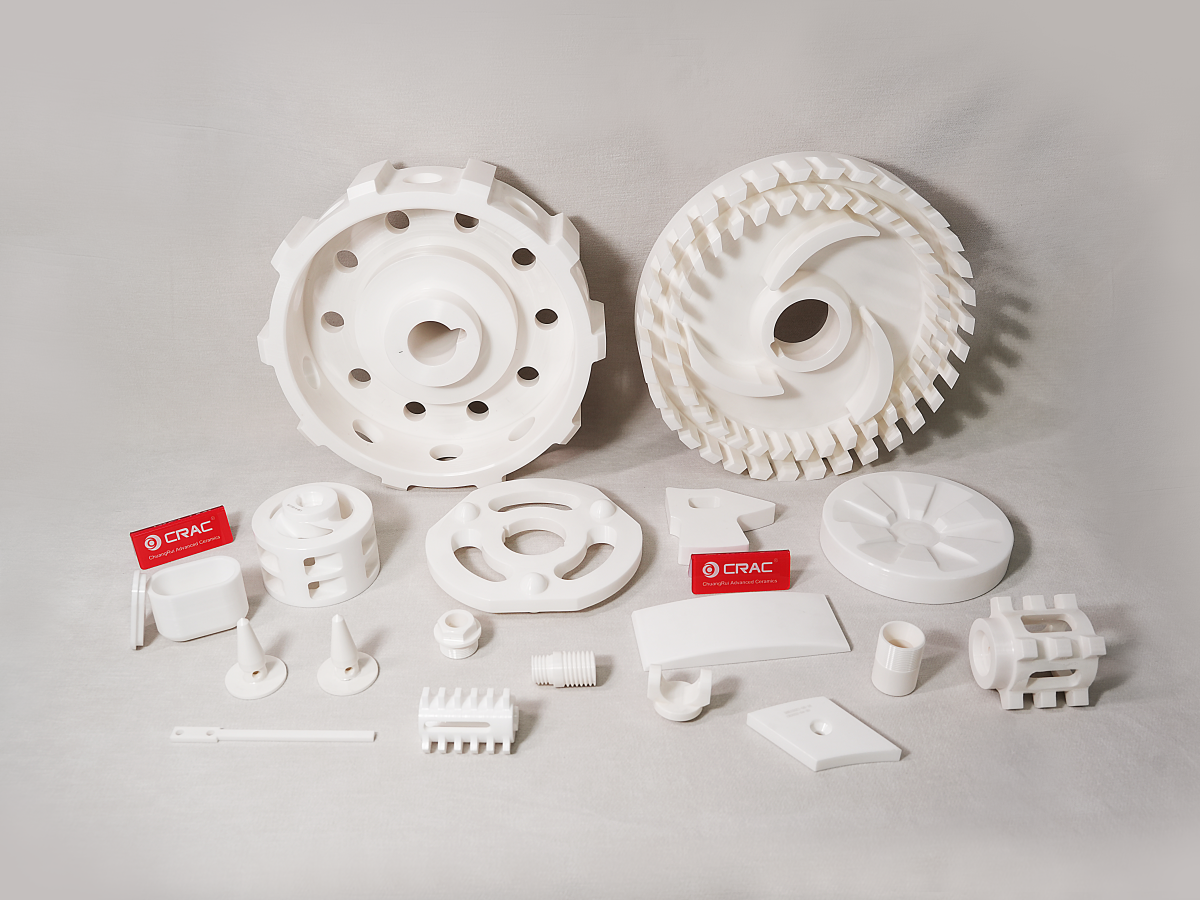
Figure 1: A selection of CRAC precision-engineered ceramic mechanical parts — including impellers, valve bodies, shafts, and structural components — manufactured from yttria-stabilized zirconia and composite ceramics for demanding industrial applications where corrosion resistance and wear performance are mission-critical.
Why Ceramic Outperforms Metal in Corrosive and High-Wear Environments
The fundamental limitation of metal mechanical parts in aggressive environments is their susceptibility to simultaneous chemical and mechanical degradation — a failure mode known as tribocorrosion. When a metal surface experiences sliding contact in a corrosive medium, the protective oxide layer is mechanically removed, exposing fresh metal to chemical attack. The rate of material loss under tribocorrosion can exceed the sum of pure corrosion and pure wear rates by an order of magnitude, making it the dominant failure mechanism in pumps, valves, mixers, and material handling equipment.
Stainless steel (304/316L) — the workhorse material for general industrial fluid handling — relies on a chromium oxide passive layer approximately 2-5 nm thick for corrosion protection. In chloride-containing environments above 50°C, this layer breaks down locally, initiating pitting corrosion that progresses at rates of 0.1-1 mm/year. Under combined erosion-corrosion from abrasive slurries (e.g., electrode material slurries in lithium battery production), stainless steel components can fail within 3-6 months of continuous operation.
Hastelloy and duplex stainless steels offer improved corrosion resistance but at 5-8× the material cost of standard stainless, and they remain vulnerable to abrasive wear. Their hardness of 2-4 GPa (Vickers HV 200-400) provides minimal resistance to hard ceramic or mineral particles carried in process streams.
Tungsten carbide (WC-Co) delivers exceptional hardness (~24 GPa) and respectable wear resistance, but the cobalt binder phase (typically 6-15 wt%) corrodes selectively in acidic environments, causing carbide grain pullout and accelerated wear. WC-Co components are also subject to galvanic corrosion when in electrical contact with less noble metals, a common occurrence in multi-material pump assemblies.
Yttria-stabilized zirconia (Y-TZP) — the material of choice for CRAC ceramic mechanical parts — addresses all these failure modes simultaneously. As a fully dense oxide ceramic with ionic bonding, zirconia is inherently immune to electrochemical corrosion (there are no free electrons to participate in redox reactions). Its hardness of 12-13 GPa provides 5-6× the wear resistance of hardened tool steel. The transformation toughening mechanism — where stress at crack tips triggers a tetragonal-to-monoclinic phase transformation with 3-5% volumetric expansion that generates compressive closure stresses — gives Y-TZP a fracture toughness of 8-10 MPa·m1/2, the highest of any monolithic ceramic.
| Property |
Y-TZP Zirconia |
316L Stainless |
Hastelloy C-276 |
WC-Co (6%) |
| Hardness (GPa) |
12-13 |
1.5-2 |
2-3 |
22-24 |
| Fracture Toughness (MPa·m1/2) |
8-10 |
>100 (ductile) |
>100 (ductile) |
6-8 |
| Acid Resistance |
Excellent |
Poor (pitting) |
Good |
Poor (Co leach) |
| Alkali Resistance |
Excellent |
Good |
Good |
Poor (Co leach) |
| Max Service Temp. (°C) |
1,200+ |
~500 |
~600 |
~500 |
| Metal Ion Contamination |
Zero |
Fe, Cr, Ni |
Ni, Mo, Cr |
W, Co |
| Thermal Expansion (10-6/K) |
10-11 |
16-17 |
12-13 |
5-6 |
The data above reveals why ceramic mechanical parts are the definitive solution when corrosion resistance and wear resistance must be delivered simultaneously. Metals sacrifice one property for the other — hardened tool steel resists wear but corrodes; stainless resists corrosion (to a point) but wears rapidly. Y-TZP zirconia delivers both properties without compromise, making it the material of choice for the most demanding chemical processing, pharmaceutical, battery manufacturing, and advanced materials applications.
CRAC Zirconia Material Grades — Matching the Grade to the Application
Not all zirconia is the same. CRAC has developed four distinct material grades, each optimized for specific operating conditions. Selecting the correct grade is the single most important decision in achieving maximum reliability from your ceramic mechanical parts.
| Material Grade |
ZrO2 Content (%) |
Flexural Strength (MPa) |
Best For |
Typical Parts |
| A-ZR (Y8 Series) |
89±0.5 |
>1,200 |
Dry grinding, severe wear |
Spools, plungers, grading wheels, mixing rods, mold inserts, shafts, liners |
| Y-ZR (3Y Series) |
94.5±0.5 |
>1,200 |
General-purpose, high purity |
Ball mill jars, turbines/impellers, nozzles, molds, tooling, shafts |
| PR-ZR (Yellow Zirconia) |
94±0.5 |
>850 |
Wire drawing, sliding wear |
Spools, tower wheels, drawing wheels, pulleys, guide rollers |
| Composite Ceramics |
Varies |
>253 (tensile) |
Impact resistance, toughness |
Valve cores (torque >200 N·m), structural components, chemically resistant housings |
The A-ZR (Y8) series is CRAC's proprietary composite-stabilized zirconia formulation, developed specifically for dry grinding and high-friction applications where standard 3Y-TZP may experience accelerated wear. Its unique stabilization chemistry provides enhanced grain boundary strength, making it the recommended choice for ceramic grading wheels, mixing rods, and liner plates in air jet mills and classifier systems.
The Y-ZR (3Y) series represents the industry-standard 3 mol% yttria-stabilized tetragonal zirconia polycrystal (3Y-TZP), delivering the optimal balance of hardness, toughness, and chemical stability. With ZrO2 content of 94.5% and flexural strength exceeding 1,200 MPa, 3Y-TZP is the go-to material for precision ceramic components operating in wet chemical environments — pump impellers, ball mill jars, and dispersion discs in bead mills.
The PR-ZR (Yellow Zirconia) series is a yellow yttria-stabilized zirconia — distinct from common market magnesium-zirconia products — with identical chemical composition and performance characteristics as white Y-TZP. Its aesthetic differentiation serves as a practical visual identifier in multi-component assemblies, and its hardness and low friction coefficient make it ideal for sliding wear applications such as wire drawing tower wheels and pulley systems where surface finish directly impacts product quality.
The Composite Ceramics series represents CRAC's innovative polymer-infiltrated ceramic technology, where a specialized polymer penetrates the ceramic grain boundary network. This approach dramatically increases fracture toughness — achieving tensile strengths of 139 MPa and valve core torque resistance exceeding 200 N·m — while maintaining excellent resistance to dilute acids, alkalis, and organic solvents. Composite ceramic valve cores, in particular, outperform both pure ceramic and metal alternatives in applications where occasional mechanical shock or improper operation could cause catastrophic failure of monolithic ceramics.
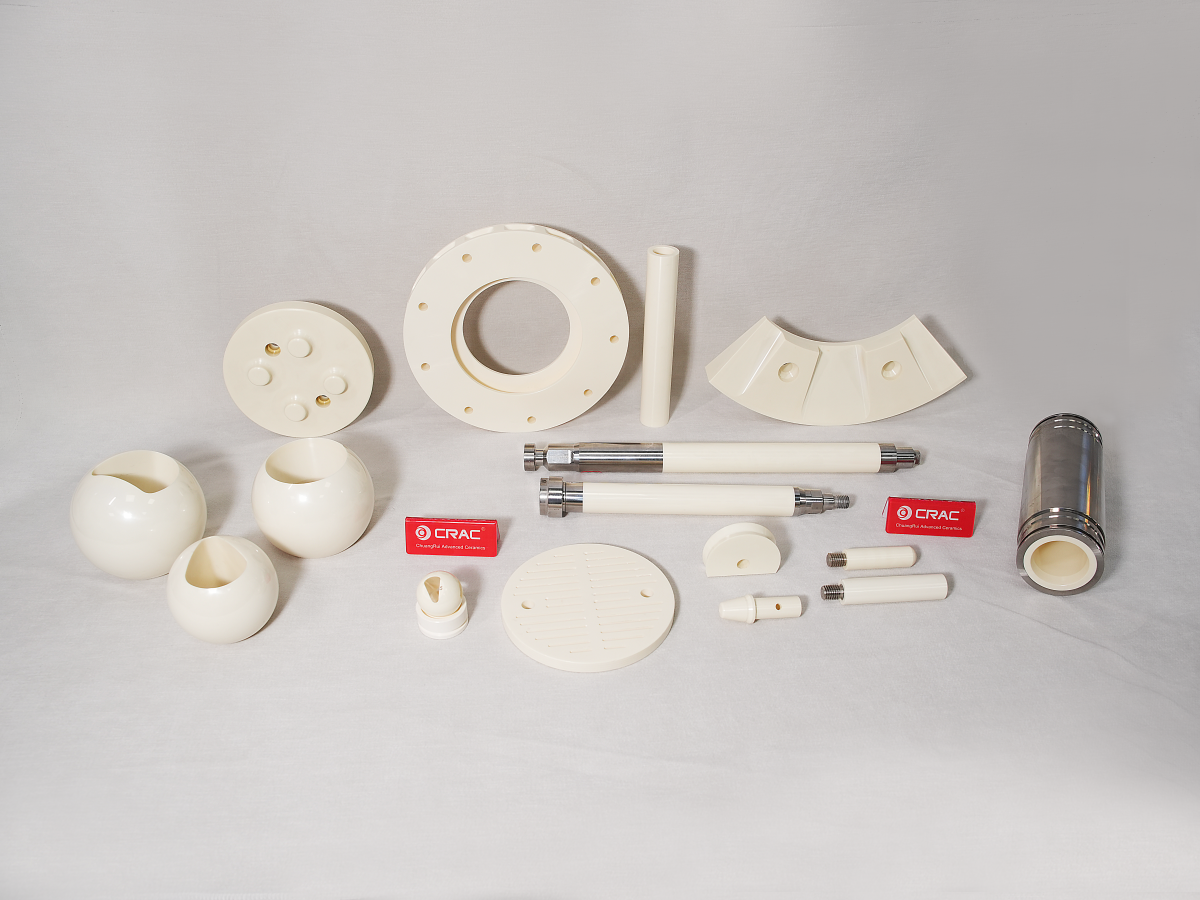
Figure 2: Precision-ground ceramic mechanical parts — including plungers, flanges, ball valve cores, and seats — manufactured from CRAC's yttria-stabilized zirconia grades, demonstrating the dimensional accuracy and surface finish achievable with advanced diamond grinding and CNC machining processes.
Key Industrial Applications of Ceramic Mechanical Parts
Ceramic mechanical parts from CRAC serve critical functions across industries where equipment reliability directly impacts production throughput, product quality, and operational cost. The following applications represent the highest-volume and highest-impact deployments of zirconia ceramic components in industrial settings worldwide.
1. Ceramic Valves — Corrosion-Proof Flow Control
Ceramic valves have become the standard for industrial flow control in petroleum refining, chemical processing, metallurgy, mining, and wastewater treatment. In these environments, the combination of corrosive media (acids, chlorides, hydrogen sulfide), abrasive particulates (catalyst fines, mineral slurries, scale), and elevated temperatures rapidly degrades metal valve seats and seals. A single leaking valve in a chemical process line can cost ,000-,000 in lost production, safety incidents, and maintenance labor — a risk eliminated by ceramic valve components.
CRAC manufactures the complete ceramic wetted-path for valve assemblies: valve bodies with internal flow passages precision-ground to Ra 0.1-0.2 μm, valve seats with lapped sealing surfaces achieving helium leak rates below 1×10⁻⁹ Pa·m3/s (ISO 15848 Class A), valve cores (ball, plug, and V-notch configurations) with dimensional accuracy of ±0.01 mm on sealing diameters, and valve sleeves with concentricity within 0.01 mm. The entire wetted surface is fabricated from structural ceramic — no metal, no coating, no compromise.
2. Ceramic Wire Drawing Components — Extended Service Life Under Continuous Abrasion
In high-speed wire drawing operations, metal wire traveling at 15-30 m/s under 50-500 N tension exerts extreme abrasive wear on guide pulleys, capstans, and tower wheels. Traditional cast iron or hardened steel drawing components develop wear grooves within weeks, which score the wire surface, degrade dimensional tolerance, and ultimately cause wire breakage — each break event stopping production for 15-30 minutes.
CRAC's yellow zirconia (PR-ZR) tower wheels and drawing wheels eliminate this failure mode. With hardness exceeding 11 GPa, these ceramic mechanical parts resist groove formation for 5-8× longer than hardened steel, maintaining consistent wire surface quality throughout their service life. The lower coefficient of friction (0.3-0.4 against steel wire, vs. 0.6-0.8 for steel-on-steel) reduces drawing force requirements by 15-25%, lowering energy consumption and enabling higher drawing speeds. Critically, CRAC's yellow zirconia is chemically identical to white Y-TZP — it is not the lower-performance magnesium-stabilized zirconia commonly found in the market — ensuring the same hardness, toughness, and dimensional stability as premium 3Y-TZP components.
3. ceramic plungers and Pump Components — Precision Dosing Without Contamination
In pharmaceutical filling systems, high-purity chemical dosing, and lithium battery electrolyte injection, ceramic plungers perform reciprocating motion within precision-bored cylinders to achieve accurate volumetric displacement. The plunger-cylinder interface is the critical wear point: any degradation of surface finish or dimensional change alters dispensed volume, contaminates the product with wear debris, and triggers costly recalibration or replacement.
zirconia ceramic plungers solve this through their unique combination of properties. Hardness of >12 GPa eliminates abrasive wear from entrained particles. Chemical inertness prevents corrosion from aggressive buffer solutions, organic solvents, and cleaning-in-place (CIP) chemicals. Thermal conductivity one-tenth that of steel provides superior insulation in applications with temperature cycling. And the coefficient of thermal expansion of ~10×10-6/K — closely matched to stainless steel — ensures stable dimensional relationships between ceramic plunger and metal housing across the operating temperature range. CRAC manufactures ceramic plungers from 5 mL to 500 mL displacement volumes and provides ceramic-to-metal bonding services using epoxy resin or ceramic adhesive for integration with metal actuator assemblies.
4. Air Jet Mill Components — Metal-Free Powder Processing
Air jet mills (fluidized bed jet mills) are the industry standard for producing ultrafine powders with narrow particle size distributions for high-value applications: battery cathode and anode materials, pharmaceutical active ingredients (APIs), advanced ceramic powders, and high-purity pigments. In these mills, compressed gas accelerates particles to supersonic velocities (300-500 m/s), creating particle-particle collisions that achieve grinding without grinding media contamination.
However, the very particle-wall impacts that are avoided in the grinding zone occur at high frequency on the mill's internal components — classifier wheels, impact rings, nozzles, and grinding chamber liners. Metal components at these locations introduce ppm-level contamination that defeats the purpose of media-free milling. CRAC provides the complete suite of ceramic air jet mill components: zirconia grading wheels with precision-balanced blade geometry for particle classification at cut points from 2-100 μm, ceramic nozzles with precisely machined throat diameters for consistent gas acceleration, and ceramic classifier housings that eliminate metal contamination from the entire product contact zone. The result is genuinely metal-free powder processing, achieving purity levels unattainable with metal-component mills.
5. Bead Mill Components — Maximum Grinding Efficiency, Minimum Wear
Horizontal and vertical bead mills — the primary grinding equipment for lithium battery electrode slurries, nano-scale pigments, pharmaceutical nanosuspensions, and ceramic inks — subject internal components to some of the most aggressive wear conditions in any industrial process. Zirconia grinding beads (0.1-2.0 mm diameter) circulating at tip speeds of 10-14 m/s create a high-energy milling environment where component materials that cannot withstand combined abrasion, erosion, and impact will fail rapidly.
CRAC manufactures the full range of zirconia bead mill components: dispersion discs (turbines) with optimized blade geometry for efficient energy transfer, rod pin sleeves with precision bores for pin-type mills, grinding blocks and screens with slot dimensions precise to ±0.05 mm, and pulleys with wear-resistant running surfaces. All components are fabricated from the Y8 (A-ZR) composite-stabilized zirconia grade, selected for its superior performance in dry and semi-dry grinding conditions. The self-wear rate of these components is measured at <0.05% of total mill throughput, compared to 0.5-2% for alumina and metal alternatives — a 10-40× improvement in component longevity.
.png)
Figure 4: CRAC yellow yttria-stabilized zirconia (PR-ZR) wire drawing tower wheel — the low friction coefficient and extreme hardness of PR-ZR ceramic eliminate groove formation and wire scoring in high-speed drawing operations, delivering 5-8x longer service life than hardened steel components.
.png)
Figure 5: CRAC yttria-stabilized zirconia ceramic plungers for high-precision pharmaceutical, chemical, and lithium battery dosing systems — ceramic plungers eliminate metal ion contamination, maintain dimensional stability across temperature cycling, and achieve 3-10x longer service intervals compared to metal alternatives.
.png)
Figure 6: CRAC ceramic grading wheel (classifier wheel) for air jet mill applications — zirconia construction eliminates metal contamination in ultra-fine powder processing, maintaining product purity at sub-ppm levels for battery materials, pharmaceutical APIs, and advanced ceramic powders.
Precision That Defines Performance — CRAC's Machining Capabilities
The theoretical advantages of ceramic materials are only realized when components are manufactured to specifications that match application requirements. CRAC's in-house machining capabilities — spanning diamond grinding, CNC machining, lapping, polishing, and ceramic-metal bonding — deliver precision that directly determines part reliability in the field.
| Precision Parameter |
CRAC Capability |
Impact on Reliability |
| Cylindricity |
0.005 mm |
Eliminates uneven wear, ensures consistent sealing along full stroke length in plungers and pistons |
| Concentricity |
0.01 mm |
Prevents vibration-induced fatigue in rotating components (turbines, impellers, grading wheels) |
| Parallelism |
0.01 mm |
Ensures uniform load distribution across sealing faces in valve seats and flange surfaces |
| Surface Roughness (Ra) |
0.05-0.1 μm |
Minimizes particle adhesion, reduces friction coefficient, enables gas-tight sealing |
| Aperture Accuracy |
0.01 mm (within 30 mm depth) |
Critical for nozzle throats, orifice plates, and precision fluid metering components |
| Internal Thread |
M4 minimum |
Enables direct ceramic-to-metal assembly without adapter sleeves for compact designs |
| Max Outer Diameter |
600 mm |
Covers industrial-scale components — large valve bodies, classifier housings, mill liners |
| Minimum Wall Thickness |
0.5 mm |
Enables thin-walled sleeves, capillary tubes, and lightweight structural components |
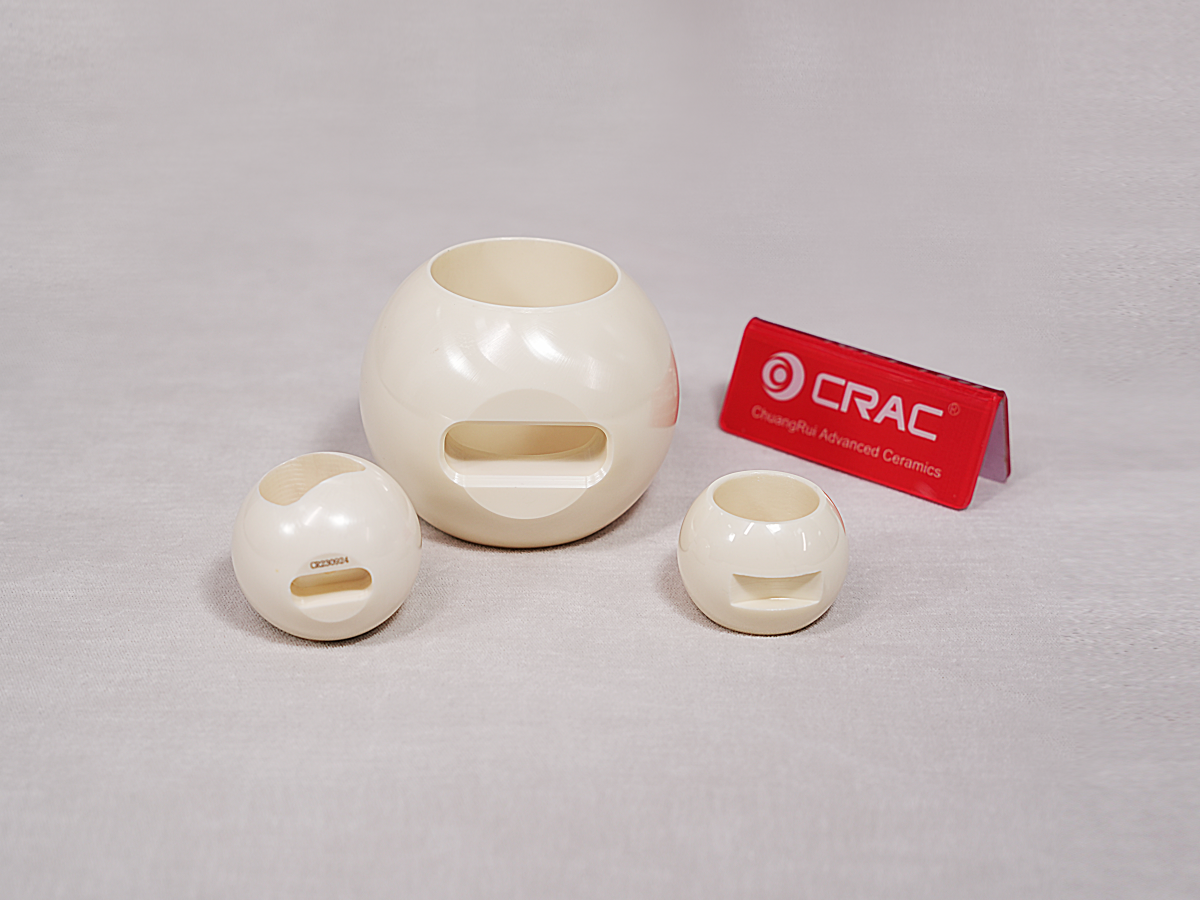
Figure 3: CRAC ceramic V-notch ball valve core with precision-ground sealing surface — the V-notch geometry provides precise flow characterization for throttling applications in chemical process control, while the fully dense Y-TZP material eliminates corrosion and wear across the entire wetted surface.
Production Quality — From Raw Powder to Finished Component
The difference between a ceramic mechanical part that lasts 10 years and one that fails in 10 months often traces back to process control — decisions made not at final inspection, but at each stage of the production workflow. CRAC's vertically integrated manufacturing process provides end-to-end traceability and quality assurance that is difficult to achieve when outsourcing individual processing steps to multiple suppliers.
Raw material qualification. Incoming zirconia powders undergo particle size analysis (laser diffraction), moisture content determination (halogen moisture analyzer), bulk density measurement (precision balance), compression performance testing, and binder content verification. Each powder lot is tested against GB/T 21114 (oxide reference materials for XRF) to verify chemical composition before release to production.
Forming. Components are shaped through die pressing or cold isostatic pressing (CIP), selected based on part geometry and required green density uniformity. Green bodies undergo CNC turning, trimming, and precision carving to achieve near-net shape, minimizing post-sintering material removal and reducing manufacturing cost.
Sintering. CRAC operates both gas-fired and electric kilns with precisely controlled atmosphere and thermal profiles. Different material grades receive sintering curves optimized for their specific composition — Y8 series components follow a higher-temperature profile to achieve full composite stabilization, while 3Y-TZP parts are sintered under conditions that maximize the tetragonal phase fraction (>95%) for optimum transformation toughening.
Precision machining. Post-sintering, components undergo diamond grinding on vertical mills (height and surface grinding), internal/external cylindrical grinding (ID/OD grinding), drilling and milling (for lower-precision features), and 5-axis CNC machining (for complex geometries and tight-tolerance features). This multi-process capability enables CRAC to manufacture parts from simple cylindrical sleeves to intricate multi-feature valve bodies within a single facility.
Inspection and certification. Conventional products undergo visual inspection and dimensional verification against drawing specifications. Critical components receive additional non-destructive testing — dye penetrant inspection to detect surface-connected porosity, and ultrasonic testing (UT) for internal flaw detection. Material certification documents including chemical composition, density per Archimedes method (GB/T 25995), hardness, and flexural strength are available for every production batch.
Selecting Ceramic Mechanical Parts — A Five-Factor Decision Framework
Systematically evaluating the following five factors will guide you to the correct material grade, design configuration, and supplier for your ceramic mechanical parts requirement.
1. Chemical environment. Identify every chemical species the part will contact — process media, cleaning agents, sterilization chemicals, atmospheric gases. Y-TZP is compatible with virtually all acids (HCl, H2SO4, HNO3), alkalis (NaOH, KOH, NH4OH), and organic solvents (alcohols, ketones, hydrocarbons). The only incompatibilities are hydrofluoric acid (HF) and hot concentrated phosphoric acid, which etch zirconia through fluoride complex formation. For mixed-chemical environments, provide CRAC's engineering team with a complete chemical list and concentration range for compatibility verification.
2. Wear mechanism. Is the wear predominantly abrasive (hard particles sliding or impacting the surface), erosive (particle-laden fluid streams), or adhesive (metal-to-ceramic sliding contact)? Abrasive wear favors the A-ZR (Y8) composite-stabilized grade. Erosive wear (nozzles, classifier components) benefits from the higher fracture toughness of 3Y-TZP. Sliding wear (bearings, seals, drawing components) takes advantage of the low friction coefficient of PR-ZR yellow zirconia. For applications involving impact or mechanical shock, composite ceramics offer the highest damage tolerance.
3. Operating temperature and thermal cycling. Zirconia's maximum service temperature exceeds 1,200°C, far beyond the capability of any metal. However, rapid thermal cycling can generate thermal stresses due to zirconia's relatively low thermal conductivity (~2-3 W/m·K). For applications with temperature swings exceeding 200°C per minute, composite ceramics or silicon carbide may be preferred. For steady-state high-temperature operation (furnace components, gas turbine seals), Y-TZP is the optimal choice.
4. Dimensional requirements. Provide part drawings with tolerances, surface finish specifications, and any geometric dimensioning and tolerancing (GD&T) callouts. CRAC's machining capabilities (cylindricity 0.005 mm, concentricity 0.01 mm, Ra 0.05 μm) meet or exceed the requirements of 95%+ of industrial ceramic mechanical part applications. If your application requires tolerances beyond these limits, CRAC's engineering team can evaluate feasibility based on part geometry and material grade.
5. Volume and lead time. Prototype quantities (1-10 pieces) can typically be delivered in 4-6 weeks, depending on complexity and whether custom tooling (molds, fixtures) is required. Production volumes benefit from optimized process flows and dedicated tooling, with standard lead times of 6-8 weeks. CRAC maintains inventory of common configurations (standard valve seats, plunger sizes, nozzle dimensions) for expedited delivery when production downtime must be minimized.
⚙
Ready to Eliminate Corrosion and Wear from Your Process Equipment?
CRAC delivers precision-engineered zirconia ceramic mechanical parts — from prototype to production — backed by 20+ years of advanced ceramics manufacturing.
🏭
Expertise You Can Trust
CRAC pioneered China's first domestically developed zirconia beads in 1997 and today supplies ceramic mechanical parts to 100+ central enterprises, state-owned corporations, and publicly listed companies worldwide.
|
🔬
Custom-Engineered Solutions
Every ceramic mechanical part is manufactured to your specifications — material grade, dimensions, tolerances, and surface finish — with full material certification and traceability documentation.
|
🚚
Rapid Turnaround
Standard configurations ship from inventory. Custom parts quoted within 48 hours with lead times of 4-8 weeks based on complexity, tooling requirements, and production volume.
|