A salon returns a batch of push shears with one line on the form: it pulls the hair. That description covers at least four different failures, and the fix is different for each one. Send the batch back to the grinder when the real cause is a bent pivot, and the second batch will fail the same way — because the complaint was never resolved, it was only answered with a replacement.
The useful thing about a shear is that it reports its own condition through the cut. A dull edge pushes, a chipped edge snags, a mis-mated pair folds the hair over instead of severing it, and a burred edge drags. Read the symptom correctly and the cause narrows to one or two operations before anything is measured under a microscope.
First Split: Is It Pushing, Snagging, or Folding?
Ask the person holding the shear, not the person who filed the complaint, and ask for a demonstration on dry hair. Three behaviours map to three different locations on the tool:
Pushing — the hair rides up the blade and the cut needs force. The edge has rounded. This is wear, and it is progressive.
Snagging — a single hair catches, the shear stops, then releases. There is a chip or a nick at one point on the edge. This is damage, and it is local.
Folding — the hair bends double and slides out uncut, most often toward the tip. The two edges are not closing against each other along their full length. This is a mating or flatness problem, not an edge problem at all.
A batch where every unit pushes points at the material or the edge angle. A batch where a few units snag points at handling, packaging or the last grinding pass. A batch that folds points at the pivot, the lapping of the mating faces, or the assembly. Those are three different conversations, and treating them as one is why repeated replacements do not stop the returns.
Why a Ceramic Edge Fails Differently From a Steel One
The instinct carried over from steel is that an edge wears gradually and gets sharpened back. Ceramic does not behave that way, and a buyer who judges it by steel expectations will misread both its life and its failure.
Yttria-stabilised zirconia runs at roughly 1200 HV against 600 to 800 HV for good blade steel, so abrasive wear at the edge is several times slower — that part of the steel intuition holds. What does not hold is the toughness. Zirconia sits around 10 MPa·m0.5 fracture toughness where blade steels are well above 30, which means the ceramic edge does not round off gracefully; under a local impact it releases a chip and stays chipped. The practical consequence is worth stating plainly: a ceramic shear does not get dull in the way a steel shear gets dull, it gets damaged. Wear life is long, but the failure is sudden and local rather than gradual, and a chip cannot be honed out on a leather strop the way a rolled steel edge can.
That single difference explains most of the field complaints that reach a ceramic supplier and should not. It also sets the design rules below — every one of them is about keeping the edge out of impact rather than making it harder. The grades and their toughness values are compared in the A-ZR, 3Y and yellow zirconia selection guide, and the wider family in the material classification guide.
The Edge Angle Is a Compromise, and Ceramic Shifts It
Included edge angle decides two things at once: how easily the edge penetrates hair, and how much load it can take before it chips. A narrower angle cuts with less force and feels sharper; it also puts less material behind the edge. Blade steel can be taken to around 15 degrees because it deforms rather than breaks. Ceramic of the same geometry will chip, so the angle is normally opened up — a few degrees wider than the equivalent steel shear, in the 20 to 25 degree range depending on the grade and the intended use.
This is where an under-specified drawing causes trouble. "Same as the steel part" is not a specification. The angle, the land width behind the edge, and the surface finish on the two faces that form the edge all have to be stated, because those three together determine whether the edge chips at the first impact or survives it. The same principle governs other thin-edged ceramic parts, which is why the wear behaviour described for zirconia parts in abrasive service is about load paths rather than hardness alone.
Burrs: The Failure That Comes From the Last Pass
A burr on a ceramic edge is a grinding artefact, not a material one, and it is the most common cause of a shear that feels sharp and drags in use. Grinding a brittle material leaves a ragged micro-edge on the side the abrasive exits. On steel, the burr is soft and is removed by a few strokes of honing. On ceramic it is hard, brittle, and breaks away in service — leaving a row of micro-chips exactly where the cutting happens.
Two process details decide whether this occurs. The direction of the final pass relative to the cutting edge, and whether a dedicated edge-honing step exists after grinding. A supplier who grinds both faces in one direction and ships is leaving a burr on one side of every edge. Ask for the process route, not the drawing tolerance: the specification will say "sharp", and sharp is not measurable.
Why the Two Blades Have to Be Lapped as a Pair
The folding failure has nothing to do with sharpness, and it is the one buyers most often misdiagnose. Shearing requires the two edges to pass each other with a controlled interference along the full length, and that depends on the flatness of the mating faces and the alignment of the pivot, not on the edge angle.
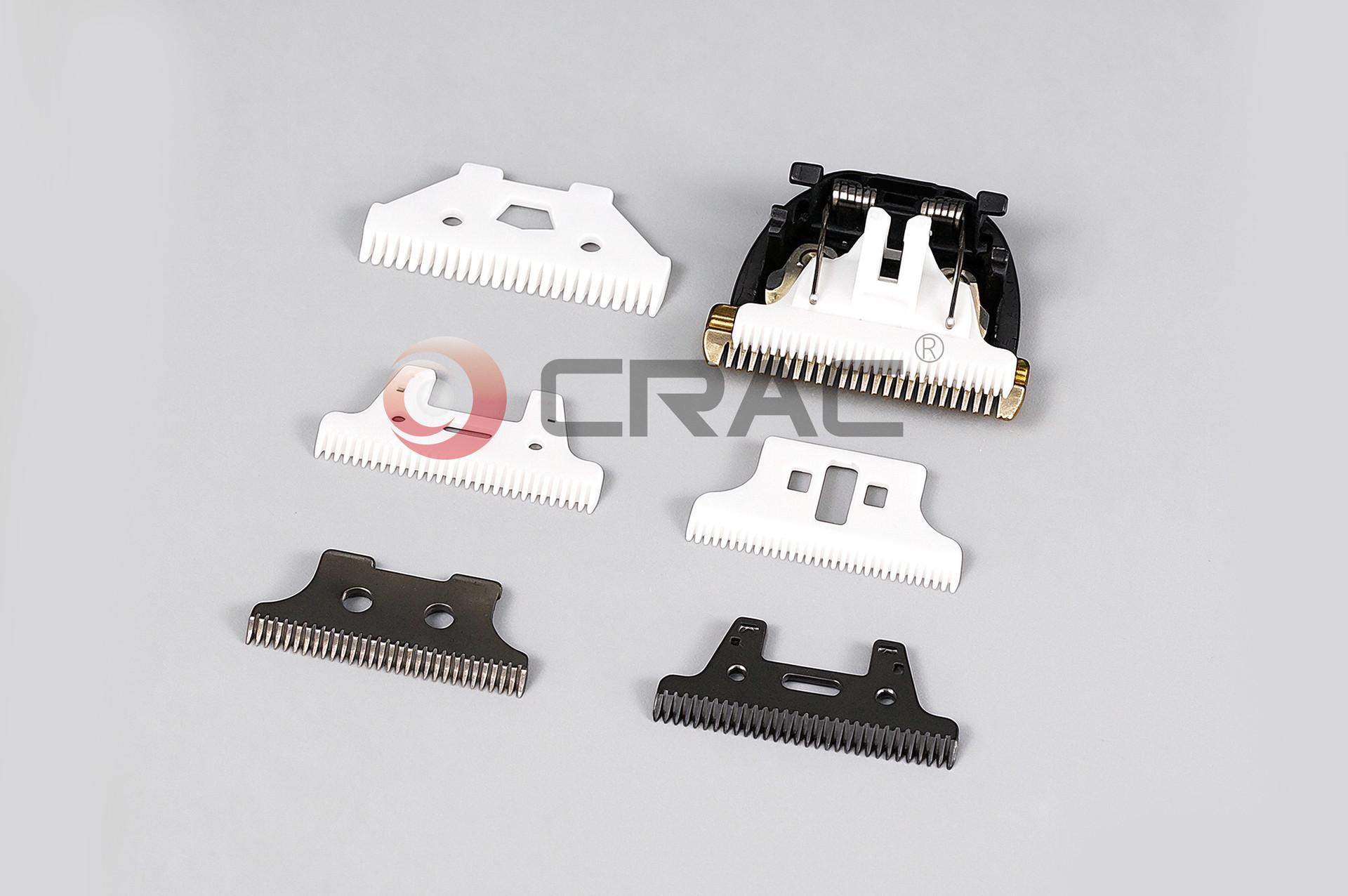
On a ceramic pair this is harder than on steel. The faces cannot be adjusted by bending after assembly — the material will crack instead of yielding — so the flatness and the pivot position have to be correct as machined, and the pair has to be lapped together so the contact runs evenly from pivot to tip. A pair assembled from two independently finished blades will usually cut well near the pivot and fold near the tip, which is precisely the complaint pattern that reads as "dull at the end". The semi-finished part below shows how much of the geometry is set before the edge is ever ground:
Symptom, Mechanism, Cause, and What Settles It
| What the user reports |
Mechanism |
Most likely cause |
What settles the question |
| Pulls hair across the whole edge | Edge radius has grown past the point where it severs | Abrasive wear, or an edge angle too wide to start with | Edge radius measurement on a new unit versus a returned one |
| Snags on a single hair | Local chip or nick | Impact in handling or packaging; edge angle below what the grade tolerates | Location of the chips — random means handling, regular means process |
| Folds hair near the tip | Edges do not close along full length | Mating-face flatness, pivot alignment, blades not lapped as a pair | Bluing or contact check along the mating faces |
| Feels sharp but drags | Burr breaking away in use | Grinding direction, no edge-honing step after grinding | Edge viewed at magnification on an unused unit |
| Both edges chip in service | Impact load exceeds what the section can carry | Grade chosen on hardness alone; land width too small | Grade and fracture toughness against the actual duty |
Two rows in that table are worth committing to memory. Chips in random positions point at what happened after manufacturing; chips in a regular pattern along the same part of every blade point at the process. And the folding row is the one that gets misdiagnosed as sharpness nine times out of ten.
Which Grade for Which Duty
Grade selection for a shear is a toughness decision first and a hardness decision second, which is the opposite of how it is usually argued. Three routes are common:
White 3Y zirconia — about 94.5 percent zirconia, bending strength from 900 MPa and toughness from 10 MPa·m0.5, hardness above 1200 HV. The default for hair shears and clipper blades: the highest toughness in the family, which is what a thin edge needs.
Yellow zirconia — around 94 percent with strength from 850 MPa and toughness from 8 MPa·m0.5. Slightly less forgiving, used where the cosmetic colour matters and the duty is lighter.
Alumina and ZTA — harder and more wear resistant, and correspondingly more brittle. Reasonable where the edge meets abrasive contamination and no impact, and a poor choice for a hand tool that gets dropped.
The counter-intuitive part is that a harder grade can shorten service life in this application. Edge retention is governed by wear resistance multiplied by survival from impact, and the second term dominates once the tool is handled by people. Where the part is visible as well as functional — shears sold as a premium hair tool sit in the same category as small cosmetic and medical components for surface and colour requirements — the grade decision should be recorded once rather than revisited lot by lot.
What to Write on the Drawing Before the First Batch
Most of the failures above are decided at the specification stage, and adding five items to the drawing costs nothing at that point:
Included edge angle, with a tolerance. Not a range inherited from the steel version.
Land width behind the edge. The feature that actually resists chipping.
Surface finish on the edge faces. An Ra limit, since friction against hair is what "smooth cut" means physically.
Mating-face flatness and the lapping requirement. State that the pair is lapped together, not two blades finished independently.
A functional test. Cut a defined fibre or hair sample a set number of times and record the force, so "sharp" becomes a number that a returned unit can be compared against.
That last item is the one that ends the argument. A supplier who can show the cut force of a new unit and the cut force of the returned one has data; without it, every return is a matter of opinion. Small, thin-section ceramic parts of this geometry are produced by injection moulding rather than pressed and ground from a blank, because the pivot and the mating faces need to be net-shaped before any edge work begins — the route is described under precision ceramic injection moulding, and shear blades sit in the same family as zirconia clipper blades where the edge is the whole product.
For a new shear or a blade replacing a steel one, the productive starting point is the drawing plus the intended duty: hair type, dry or wet cutting, and whether the tool will be dropped in normal use. Those three answers fix the grade and the edge angle before a tool is cut. Custom profiles are developed from a drawing through the OEM and ODM programme and the custom structural parts capability.
Send the drawing and the cutting duty — we will confirm grade and edge geometry.